Feb 8, 2010

Lotte Reiniger - Amanda Bonaiuto 2-8-10


Lotte Reiniger caught my attention initially with her elegant use of silhouettes and her amazing craftsmanship. Though it was not odd for an upper class woman to do such things as silhouette cut-outs, ascribed to women because of it's femininity and elegance, no other artist had quite the same intrinsic talent as Lotte. The intricacy in each of her cut-out characters is extremely admirable, especially once you are aware how much precision and effort was put into each piece.

Reiniger was extremely courageous and quite independent when it came to her work. This attitude could be considered Avant-Garde in the sense that most artists didn't become quite so independent as Lotte with their work at that time, especially women. Though slightly avant-garde, she also worked rather traditionally in terms of her subject matter. Her whimsical, romantic fairy-tale like stories were very feminine and less radical. Her subject matter spoke to an early, innocent age. Reiniger was extremely prolific and created about 70 films by the time of her death, though she only made one feature-length animation film.

http://www.fact-index.com/l/lo/lotte_reiniger.html


Here's Lotte's version of Hansel and Gretel-
Contemporary Silhouette Animation(sort of). Not made with cut-outs, but real objects back lit.


Call for Talent! Annecy Festival Competition on YouTube
An event not to be missed!


50 years of creativity, innovation and technology – that's worth celebrating!
For its anniversary, the Festival is teaming up with YouTube to organise an original competition...

Open to all, it gives budding creators, students or industry professionals the opportunity to be a part of a world-renowned Festival.

Feel like being creative, making an animated film or adpating an existing production?

Taking part could not be easier: simply upload your film to YouTube between 1st February and midnight on 1st May 2010.

The film must be of a maximum running time of 5 minutes, be centerd on the theme of celebrations and anniversary and integrate the keywords: "50", "Festival" and "Annecy".

This is your chance to really get involved in the Festival!

The competition will run on the YouTube channel of the Annecy Festival where entrants can get all the latest news as of today: www.youtube.com/annecyfestival

From 2nd May, users will vote for the 10 best shorts (voting ends at midnight on 23rd May). A jury of professionals will then choose the winner from the 10 finalists (making their decision between 24th and 27th May).

The prizewinner will be treated to a week at Annecy 2010, taking place between 7th and 12th June, and the winning film will be screened during the event.

Happy Birthday Mister Festival!


Contacts Communication:
Laurence Ythier, Head of Communications
Cindy Bazaugour, Communications Assistant

For further info: CITIA +33 (0)4 50 10 09 00 Official website www.annecy.org

Feb 7, 2010

Motion Portraiture and Self-Portraiture: Cornell Cinema

Call for Submissions – Deadline: March 15, 2010

The Cornell Council for the Arts, Prudence Risley Residential College for the Creative and Performing Arts at Cornell University, and Cornell Cinema invite submissions of motion portraits and self-portraits for a curated screening.

Through this open call, we seek to uncover the full depth and range of contemporary portraiture and self-portraiture in time-based arts. Broad interpretations of “portrait” and “self-portrait” are welcome. Accepting all artworks which can be screened in video (including film, video, motion graphics, animation, programming, game interfaces, flip books, etc.) Due to scheduling limitations, works under 5 minutes preferred. Exhibition of the curated show will be at Cornell Cinema in April 2010.

Curated by Darren Douglas Floyd, Artist-In-Residence, Film and Video, Cornell University, 2009-2010 (web.mac.com/humiliated) with the assistance of Cornell University students.

Deadline: All entries must be postmarked by March 15th, 2010.
There is no entry fee.

Please send submissions as .mov data files on DVD to:
Open Call: Motion Portraiture and Self-Portraiture
c/o Darren Douglas Floyd, AIR
123 Risley Hall
Cornell University
Ithaca, NY 14853-5801

Generous funding and support for this project is provided by The Cornell Council for the Arts, Prudence Risley Residential College for the Creative and Performing Arts at Cornell University, and Cornell Cinema.

cca.cornell.edu
www.risley.org
cinema.cornell.edu

For more information please direct queries to Darren Douglas Floyd, Artist-In-Residence in Film and Video, Cornell University, 2009-2010 at df278@cornell.edu.

Women's Animation Festival


The first ever

film festival

It's women ... It's animation ... It's Womanimation!

Saturday, March 28, 2009

Red River Theaters

Concord, NH

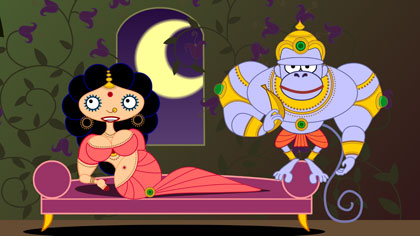
What is Womanimation? As the name implies, it's a festival showcasing animated films, both short and feature-length, created by women from the US and Europe.

The festival takes place in conjunction with the second international SWAN Day (Support Women Artists Now), an event designed to highlight the contributions of women artists, as March is Women’s History Month.

Some films explore women’s issues such as menopause and spousal abuse; others deal with broader themes such as environmental degradation and career burnout.

Satire, drama, documentary, experimental - in styles from traditional 2-d to stop-motion to computer animation - the festival features something for every taste.

To see a list of films, click here.

Tentative Schedule (check theater website for details)

Matinee Showings

1:00 pm: Sita Sings the Blues (w/Andaluz)

3:00 pm: Shorts program

4:30 pm: Q&A/mingle

Evening Showings

6:00 pm: Sita Sings the Blues (w/Andaluz)

8:00 pm: Shorts program

9:30 pm: Q&A/mingle; reception w/music by DJ Madame B

Feb 4, 2010

early abstract animations


Oskar Fischinger's works were not driven by a narrative but by his fascination with music and his desire to express music in visual terms. He insisted on working abstractly to try to realize his vision. Many of his works are influenced by Jazz. He often used bright colors and purely geometric elements in his experimental short animations. Fischinger was not the only artist in his generation to be influenced by music in his visual works. Another artist that comes to mind is Vassily Kandinsky, who often used musical terms such as "composition", "improvisation", etc. to talk about his paintings. Another contemporaneous artist with Fischinger exploring music in his geometric abstract paintings is Piet Mondrian. The piece that has been quoted to be most directly influenced by the rhythm of Jazz is "Broadway Boogie Woogie". Fischinger's fellow animator from New Zealand, Len Lye shares his interest in visualizing music. Similar to Fischinger, Lye also often used bright colors, simplified geometric shapes and repetitive patterns. Unlike Fischinger though, Lye was using a "camera-less technique" and was directly working on film. He would draw and paint straight onto the celluloid film. One of his most stunning animations is "A Colour Box" was the first to be screened for the general public advertising cheaper parcel post. (I have found several versions of this online, with radically different colors. Here is the link that had the brightest colors...) "A Colour Box", 1935.
Another short experimental animation piece by him worth seeing is "Swinging the Lambeth Walk".

Posted by Eszter

Feb 3, 2010

The Introduction of the Sound Short


Walt Disney's 1928 short Plane Crazy was the first animation to feature sound, which revolutionized both animation and live action films. Disney co-directed with Ub Iwerks, a highly skilled and devoted animator who apparently "out produced other animators 2 to 1 drawing 700 frames a day on Plane Crazy" (ASIFA Animation Archive). Author Norman Klein describes Plane Crazy as having a more volumetric quality than Felix the Cat shorts that were out at the same time, paving the way for more believable movement that Disney had pushed for in the late 1920s.

(Phylicia F.)

Fleischer Studios' toons to Talkartoons

During the 1930s, there were only two serious giants in the animation field. The first was, of course, Walt Disney Studios. But the other, an outfit that has been sadly neglected today, was Fleischer Studios, run by Max Fleischer and his talented brother Dave.


Max was especially fascinated with technological innovation, as well as art. He had worked in the art department of the Brooklyn Daily Eagle (even introducing a short-lived comic strip, Little Elmo, in 1904), before becoming the art editor at Popular Science Monthly in 1914. In 1911, he created the rotoscope, an animation innovation that is still used today in one form or another. Rotoscoping allows an animator to film a complex movement with a live action actor, and then animate over that actor, producing (in theory) realistic movement in cartoon form: this is the grandfather of the motion capture techniques used to create Gollum in Peter Jackson's The Lord of the Rings, and the dead-eyed soulless things in Polar Express. Fleischer was granted a patent for the rotoscope in 1917, but found out later that a similar device had already been invented (which is why he didn't sue Disney for using it in Snow White and the Seven Dwarfs in 1937).

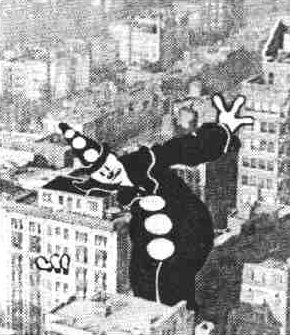
The rotoscope was tested by filming Dave gamboling in a clown suit, and animating a full cartoon over it. The process took nearly a year; when Max tried to sell the film to Pathe in 1916, they were impressed but felt a year was laughable for cartoon production. Max came up with another idea: wrap a live action introduction and ending around the cartoon, with the animated clown capering around on a blank sheet of paper or playing with drawing supplies. By introducing a significant live action element, production time was cut down. Out of the Inkwell was born. John R. Bray saw it, loved it, and offered them a spot in his Paramount-Bray Pictograph film magazine.

Before that, however, there was a war to fight: Max made training films for Bray, while Dave worked in the US Army as a film cutter. They still managed to turn out a few films, such as the lyrical Experiment No. 1 (1918), but it wasn't until after the war that production on an Out of the Inkwell series could begin in earnest. Though the series was meant to be monthly, it could never keep that schedule. However, the series proved popular. From a technical standpoint, the rotoscoping allowed a smoother animation than anyone else's. Dave directed, did story, and acted in the clown suit as one of the earliest recurring cartoon characters, KoKo the Clown. Max, however, was quick to claim credit, and the two brothers would clash fiercely. In 1921, they formed Out of the Inkwell Films, Inc., and were able to hire animators (as well as their younger brother Joe as an electrician and camerman). They not only produced more KoKo cartoons, but worked on educational cartoons, such as The Einstein Theory of Relativity (1923, commended by Albert Einstein himself) and Darwin's Theory of Evolution (1923, which was not shown in the South).
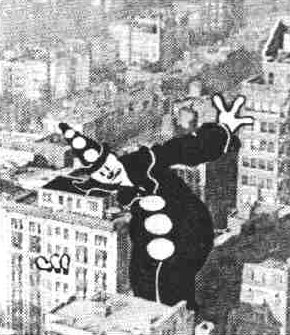
Always attempting to innovate, Max Fleischer soon created the KoKo's Song Car-Tunes series. In this series, KoKo the Clown would step out of the inkwell, change into a conductor's suit, and the lyrics to a song would appear on screen. Then a bouncing ball would jump onto each lyric to prompt the audience to sing along while an organist played the music. It started with Oh Mabel in 1924 and became quite a crowd-pleaser, continuing on until 1927 (and was briefly revived in 1929 as the Screen Songs series). To achieve this, Max created synchronized sound for the films so that the live audience and the bouncing ball would be in synch. Unfortunately, he didn't realize that layering the sound onto the film was a simple matter (he had already figured out the timing), so Disney beat him to sound.

Max also invented an important process: the in-between animator. In animation, most animators (think of today's greats like Andreas Deja and Glen Keane) draw only key shots, while an in-betweener comes in and draws the action between the key shots. Max came up with the notion (based on Bray's assembly-line theory), along with animator (and future Disney vet) Dick Huemer. Max also attempted to move into distribution--Margaret J. Winkler had developed a state-to-state system of middle-men which saw royalties arrive too late from individual theaters--and formed Red Seal Pictures in 1924. Unfortunately, Red Seal went bankrupt within two years. Fleischer again tried to distribute his own pictures under a company called The Inkwell Imps, but the independent producer Max had allied himself with, Alfred Weiss, was a crook and went out of business. Max's dream of independence was crushed, and instead he set himself up at Paramount Pictures. Although the company was called Fleischer Studios Inc., the company was a subsidiary of Paramount, who would hold all the copyrights.

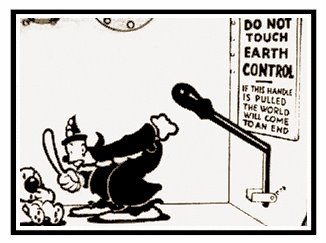
Sound devastated the animation field in 1927, and only those who could adapt quickly survived. Max took up sound and ran with it in 1929, creating the Screen Songs series (bouncing ball still firmly in place) with The Sidewalks of New York. Even though the Out of the Inkwell series was still fun--the cartoon KoKo's Earth Control (1927) in which KoKo and his dog Bimbo find a lever that accidentally destroys the planet, is a surreal masterpiece--Max saw sound coming and decided the adventures of KoKo had come to an end. Lest he become a relic like Felix the Cat was about to, Dave made KoKo Needles the Boss (1927) the last Out of the Inkwell cartoon.
Trumpeting the advent of sound, the Fleischers created a new series called Talkartoons, a series which was meant to star KoKo's dog Bimbo for a sense of continuity and audience identification. The first Talkartoon, Noah's Lark, premiered in October 1929. It featured music in much the same way Disney's Silly Symphonies, developed concurrently, did. Another Fleischer brother, Lou, was hired as musical director.

For more information continue on to this website

-angela

Krazy Kat

I really enjoyed "Krazy Kat Goes A-Wooing". I found the premise of Krazy's unrequited love and his constant misinterpretation of Ignatz's brick trowing behavior for love hilarious. I also thought that Krazy's sometimes ambiguous gender would be an interesting topic to explore. Supposedly Krazy's creator, George Herriman thought of Krazy as a kind of spirit, gender neutral. I think that might be too easy of an answer and that the cartoons themselves offer rich territory to think about gender roles and relationships at the time (and even today).
A video I found interesting and relevant to the topic is "Krazy Kat and Ignatz Mouse at the Circus". Note the little condescending comments about women, "Shux that ain't brave anyone can scare mere womans"...
I also found a contemporary claymation version of Krazy Kat that does a good (and funny) job of summarizing the love triangle that provides the main storyline in Krazy Kat. Enjoy!

Posted by Eszter

Ambiguous Black and White Animals

During this class we watched some Felix the Cat and Oswald the Lucky Rabbit. Now, as a child, it was my understanding that Disney cartoons, and other strange cat-like animals enjoyed singing and dancing and occasionally flying airplanes. This is not entirely true. As we watched last week, Felix the Cat also enjoys dislocating his tail, and huff fumes to avoid fatherhood. Oswald discovered that hot dogs can feel pain, but continued selling them. Watching these really makes me wish I couldve been an animator in this time, where you could be as pollitically incorrect as you wanted and everyones ok with that. what a time. Ultimately it was good to see the progression of Mickey Mouse and other cartoon icons, especially in their almost neanderthal stage of backwards messages and zero censorship, which is my favorite kind of censorship. I look forward to the shockingly offensive material yet to come.

Alice's Wonderland...Stephen Bevilacqua

"Alice's Wonderland" was the first of its kind and revolutionized the whole concept of film and animation as mediums. Its influence would be felt for years, through "Who Framed Roger Rabbit" to "Space Jam." In terms of entertainment this isn't the best - I'm giving it a seven out of ten based on a few factors, mainly I'm taking into consideration its effect and importance. Graded against today's animation it is, of course, very dated. It was the first of it's kind and start a new look into animation.
In reading 7 min. i was particularly intrigued that Max Fleischer Aryanized his name for Nazi Germany. Then got to thinking about animation and social uprisings and wanting to know more about animations being played in Nazi Germany as well as if there was anything coming out of Spain around this time. One of what few i found . . Animated by Hans Fischerkoesen showed 1943 the song sung at the end supposedly translates to“This is the summer of my life, how beautiful you are in your dress of flowers. Who ever saw you did not live in vain, my heart melts in sheer bliss . . . How beautiful you are …” . also the animator of "Das Dumme Ganslien( The Silly Goose) Das Gespenst( the Ghost)".

Entirely separate but connected in some way i stumbled upon "The King of Jazz" (1930) Staring Paul Whiteman( White and the king of Jazz) Created by Walter Lantz & was the first two strip Technicolor. Rather funny Rather racist this cartoon ends with the explanation of how Paul Whiteman became the "King of Jazz". A monkey throws a coconut hitting him on the head where a lump in the shape of a crown Grows.

The Devil's Ball-Amelia D.


I recently found out that Ladislaw Starewicz's stop motion film "The Mascot" was named one of Terry Gilliam's Top 10 Best Animated Films Of All Time. Yikes. That's a pretty rad honor. Other names on that list include works by Svankmajer, The Brothers Quay, and...South Park. Hmmm...

Anyway, I figured I'd post about "The Mascot" because not only is it hugely influential, but it's also really well done. One part I particularly enjoyed from it was the segment entitled "The Devil's Ball". If you haven't seen "The Mascot" before, it's about a toy puppy who comes to life and goes on this epic quest to find an orange for a sick little girl ( I think she had scurvy or something like that)
This part of the movie is about him going through a ton of ridiculous stuff just to get this orange back to the girl.
Ladislaw Starewicz- The Devil's Ball

Also, here is the link to Terry Gilliam's list of the best animated features.