A blog from the Animation crew at the School of the Museum of Fine Arts in Boston, MA.
Mar 30, 2011
Particles
Norman McLaren's Soundscapes and the use of Jazz in Abstract Animations
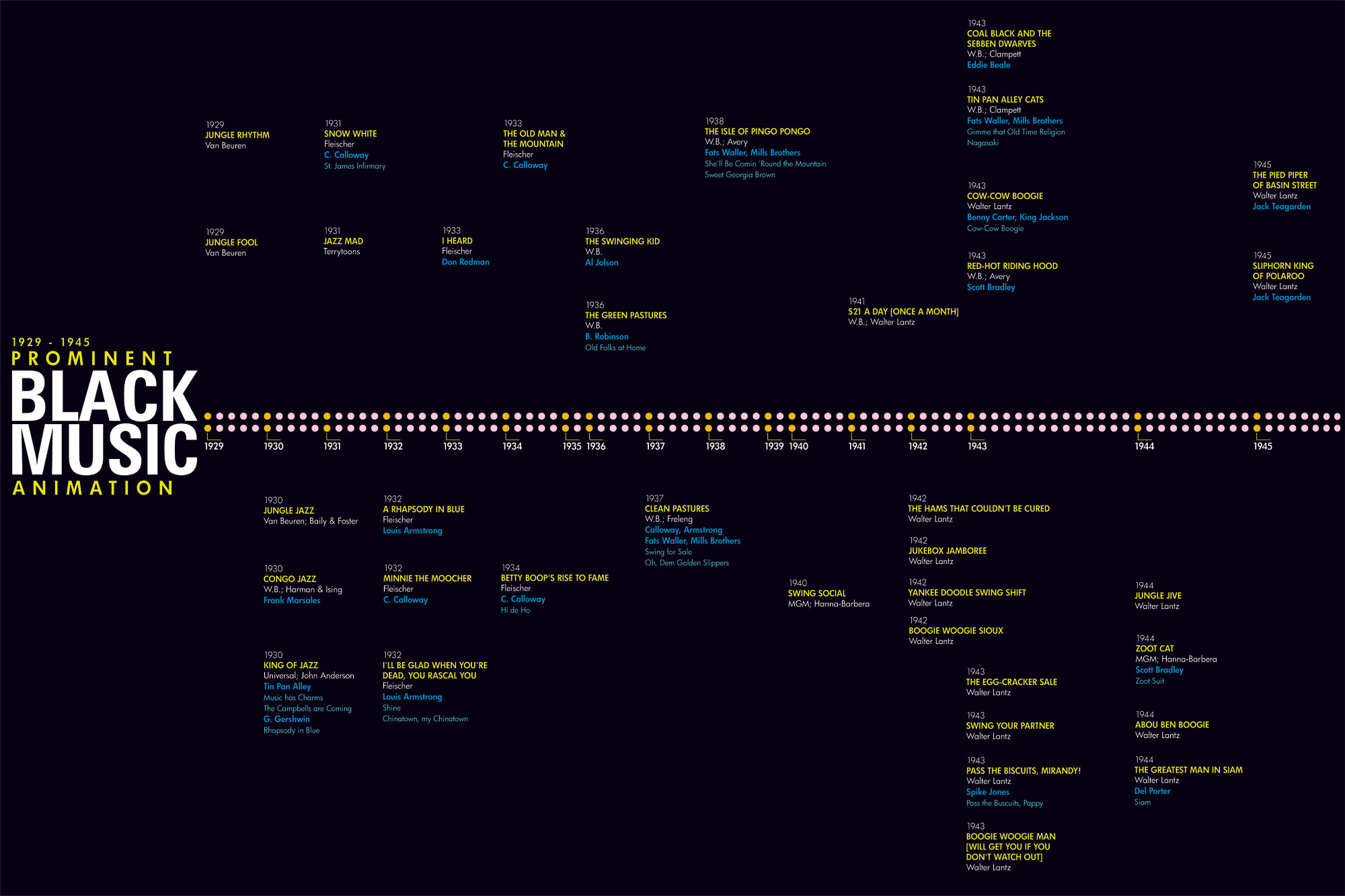
The still above is from Norman McLaren's (1914-87) animation, Neighbours, from 1952. Although in itself it is not a non-objective abstracted animation, the soundtrack functions in itself as a form of abstracting the visual dialogue that unfolds throughout the duration of the animation. With bleeps and bloops that form an electronic soundscape the piece easily dissolves into a wordless dispute that explores semiotics and language through the minimalist environment created by the soundtrack.Upon further investigation of the use of sound as a means to further a dialogue with abstraction through animation I was lead to a posting on Cartoon Brew about the utilization of jazz within animation shorts--again not particularly of the non-objective variety, but more as the precursors to the use of jazz and music as an elaboration and companion to abstract forms and content. In explanation of some of the music used as a means of reinforcing the abstracted landscape being created in these animations, a timeline of information was offered to give a sense of how vital jazz and music in general was to the animations during much of the 1930s, 40s, and 50s.

The end of the posting mentions that animators like McLaren carried on this tradition. McLaren is noted for collaborations with jazz artist Albert Ammons, and film composer Eldon Rathburn--both pictured above.
Reference:
Cartoon Brew
|| Post by: Stephanie Clark ||
L'Illusionniste 2010, A Love Letter from Tati

After doing some research and coming up with nothing too remarkably sound-related, I found I couldn't focus on anything after I saw L'Illusioniste last Thursday at Kendall Square Cinema. I first saw advertisements for the film, directed by Triplets-famed Sylvain Chomet, while studying abroad in Paris, and it was unfortunately so close to the end of my stay that I couldn't see it there in a Parisian cinématheque. However, it stayed on my mind since as the one film I was absolutely aching to see-- I had obviously seen and loved The Triplets of Belleville and was super thrilled to see a new film from the creators.
Line Dance
Mary Ellen bute
Mary Ellen Bute was one of the first female abstract animators. She first studied painting in Philadelphia but felt this medium did not enable her to use light in the way she desired.She then studied stage lighting at Yale University where she took great interest in the color organ ( a device that demonstrates how sound influences light colors) eventually creating her own. From that point Bute became very interested in electronic art as well as translating sound into a visual animated art form. Bute studied amongst avant-garde musicians Joseph Schillinger and Leon Theremin who collaborated with her on many pieces. Together they used optical color projection synchronized to music. Bute's work is visually poetic focusing on movement form and color exemplified in Spook Sport (1939) and Synchromy No. 4(1938): Escape; Her films also display a great influence of science and mathematics. Although Bute is not very well known today, this was not always the case. Many of her animations appeared in movie theaters as shorts before a feature film. This allowed her work to be seen by a large amount of people a luxury many abstract artists did not get to experience.In Synchromy No.4 one can definitely see the influence of science and math with the different geometric shapes and grids. These images are combined with a very free flowing background that looks like liquid or clouds.
source
callie
John Whitney

John Whitney is sometimes called the father of computer animation. Although he started by making films on 8mm, and in 1939, he and his brother, James, began to make more abstract films. One of their pieces, Five Film Exercise, was given the first place prize at the International Experimental Film Competition in 1949.
Whitney, having been an inventor and having experience with computers, used these skills to make commercials for television during the 1950's. He, along with Saul Bass, made a sequence for the movie Vertigo, by Alfred Hitchcock. This fulled his interest in using computers to make animations and film. In the 1960's, Whitney opened Motion Graphics Incorporated, where he continued to make motion graphics and sequences for television. IBM saw what Whitney was creating and offered him a job in 1966 as a resident artist. While working, Whitney became interested in the processing language and medium. He used this to create the work Arabesque, a film using lines and color set to music.

I personally found Arabesque to be beautiful and intriguing. I have been taking a course in processing and wanted to see if there was a way I could re-create parts of Arabesque on my own. The code for it took time and involves much more to make the entire sequence that Whitney made, but I found a way to make the linear set that transforms into dots. Here is a link to this piece.
source
|-Kelly-|
Beyond the Caribbean Islands
Why Momotaro?
I see Skies of Blue, Clouds of white, Bright blessed day, when I listen to tunes, and I think to myself… “what a colorful view!”
Synesthesia is a rare, yet incredible condition, which allows the individual with said condition to literally see sound! Being somebody with mild Synesthesia, I get a taste of it whenever I listen to music, so I know automatically what to picture when Synesthesia is brought up; but for those of you without the condition, mild, or full blast, what I found to be the most accurate depiction of what synesthetes see or imagine when they listen to music, would be the opening song of Fantasia, when they played Toccata and Fugue in D Minor. It’s actually a very interesting condition, studies show that most synesthetes do not even realize they have the condition until they discover that people around them are not envisioning the shapes, colors, and patterns that they are when they listen to music, or sound. Most cases have shown Synesthesia to be harmless, or non-influential to the subject’s patterns of behavior, however, there are still the occasional few who report experiencing “sensory overloads” when the sensation is triggered. As for what does trigger Synesthesia to synesthetes varies. The most common form of Synesthesia is called “Grapheme” or “color Synesthesia”, which causes letters and numbers to appear to give off colors. For example, S might look like S, or A might look like A. Other forms are Sound Synesthesia, which causes a variety of sounds to look like shapes, lights and colors. It was this form of Synesthesia, which inspired the creation of “Synesthetic Art”, or art that is either created by synesthetes to express what they experience, or artists who are trying to replicate the condition through physical visual means. Such examples would include a variety of inventions, such as the Lumigraph, or “Color Organ” which was developed by an animator named Oskar Fischinger, and would give off colors of light that would accompany the music that the organ would play. Other examples were works of art, such as “Vision” by Carol Steen, which supposedly portrayed what she would picture during acupuncture. For many hundreds of years, Synesthesia was not a widely investigated phenomenon by the scientific community, and it’s only been until recent times when the condition has actually been acknowledged at all. Many famous Synesthetes include ancient Greek Philosophers who described seeing the color timbre when they listened to music. Others include Isaac Newton, who proposed that the frequencies of color and music were interrelated. Even the father of modern electricity, Nikola Tesla was supposedly a synesthete. Overall, Synesthesia is neither a normal sensation, nor a handicap, and throughout history has made significant contributions to both the artistic, and scientific fields, both intellectually, and creatively.
- Jon
(Image is "Vision" by Carol Steen, image was taken from Wikipedia)
Oskar Fischinger's Lumigraph
Being an abstract animator, Oskar Fischinger wanted a machine to help him make spectacular light arrangements to be paired up with music. He invented the Lumigraph, a type of "color organ," a term describing a wide array of electromechanical machines that were capable of producing visuals in accordance with sound. These machines had a variety of ways of doing so. "Color Organ" was a name that arose in the 60s and 70s due to the colorful light shows that these machines produced to go along with music or sound.
Oskar's machine created thin beams of light by exerting pressure on a rubberized screen. The size of the performer dictated how big the screen could be (how high the performer could reach). In order for the device to function properly, operation involved two people. One to maneuver the screen to produce imagery, and another to altar the lights when necessary. Oskar did shows in LA and San Francisco, and the machine was involved in the creation of the movie The Time Travelers in 1964. In this instance, the Lumigraph was referred to as a "Lumichord" according to the producers, not Oskar. Oskar's son constructed two more of the devices varying in size. And the Lumigraph continued to perform at the hands of Oskar's wife after his death. A Lumigraph that she used remains in a museum in Germany, and still performs occasionally.
Info: http://en.wikipedia.org/wiki/Oskar_Fischinger
http://en.wikipedia.org/wiki/Color_organ
Image: http://www.centerforvisualmusic.org/Fischinger/Lumigraph.htm
Post By Luke
Mar 29, 2011
Fran the Man's Sketchbook Animation
Mar 16, 2011