Watching abstract animations reminded me heavily of trying to explain what a migraine can "look" like from the affected brain. As someone who suffers from frequent migraines, sometimes triggered by light or flashing, I can speak from personal experience as to there being a noticeably different visual experience from the brain experiencing normal function, to a brain under the affects of a migraine. Abstract animation relates heavily to the function of the brain by directly referencing biorhythms and the brain's ability to "understand" visual cues- and migraine headaches are heavily influenced by the brain's own biorhythms. Light sensitivity can grow or recede, the pounding of blood can have different rhythms, the fogginess around the outside of your field of vision can rapidly grow and retreat. Migraines, as awful as they are to experience, can be fascinating, and even visually beautiful. The following are animations made by different people who experience migraines and the different ways they have visually described their migraines experiences.
~Katrina~
Mar 30, 2011


Pixilation
Pixilation is a type of stop-motion animation that uses people instead of things such as objects or puppets. One of the earliest experiments with this form of art was in 1909, when Segundo de Chomón created a comedy-fantasy called, El hotel eléctrico. The film is a surreal short that depicts a suit case unpacking and furniture rapid swirling around in a room. The film was a part in several attempts at pixilation for Chomón.
-Matt
Particles
After the screening of abstract animation, I couldn't help but think of the influence these experimental, explorative works had on special effects in filming. Abstractions are and integral part of reality, reality is after all an intricate pattern of abstraction. Layering these abstract techniques on top of film would make for infinite possibilities in the realms of both natural and super natural effects. Science Fiction films took total advantage of this application.
Of course animation had been playing a role in film effects for quite some time prior to this surge of abstract work. But this was a particularly important for particle effects, such as the ones seen in Forbidden Planet.
Inspired by the abstract landscape of music, these pioneers opened up a wide spectrum of possibilities for future animators to build upon, and the applications of these techniques continue to grow. Particle effects are used for a variety of media both video games and film employ the clever use of abstraction in combination with other elements including sound and other representational elements for a seamless illusion.
tim \( '<->' )/
Norman McLaren's Soundscapes and the use of Jazz in Abstract Animations
 The still above is from Norman McLaren's (1914-87) animation, Neighbours, from 1952. Although in itself it is not a non-objective abstracted animation, the soundtrack functions in itself as a form of abstracting the visual dialogue that unfolds throughout the duration of the animation. With bleeps and bloops that form an electronic soundscape the piece easily dissolves into a wordless dispute that explores semiotics and language through the minimalist environment created by the soundtrack.
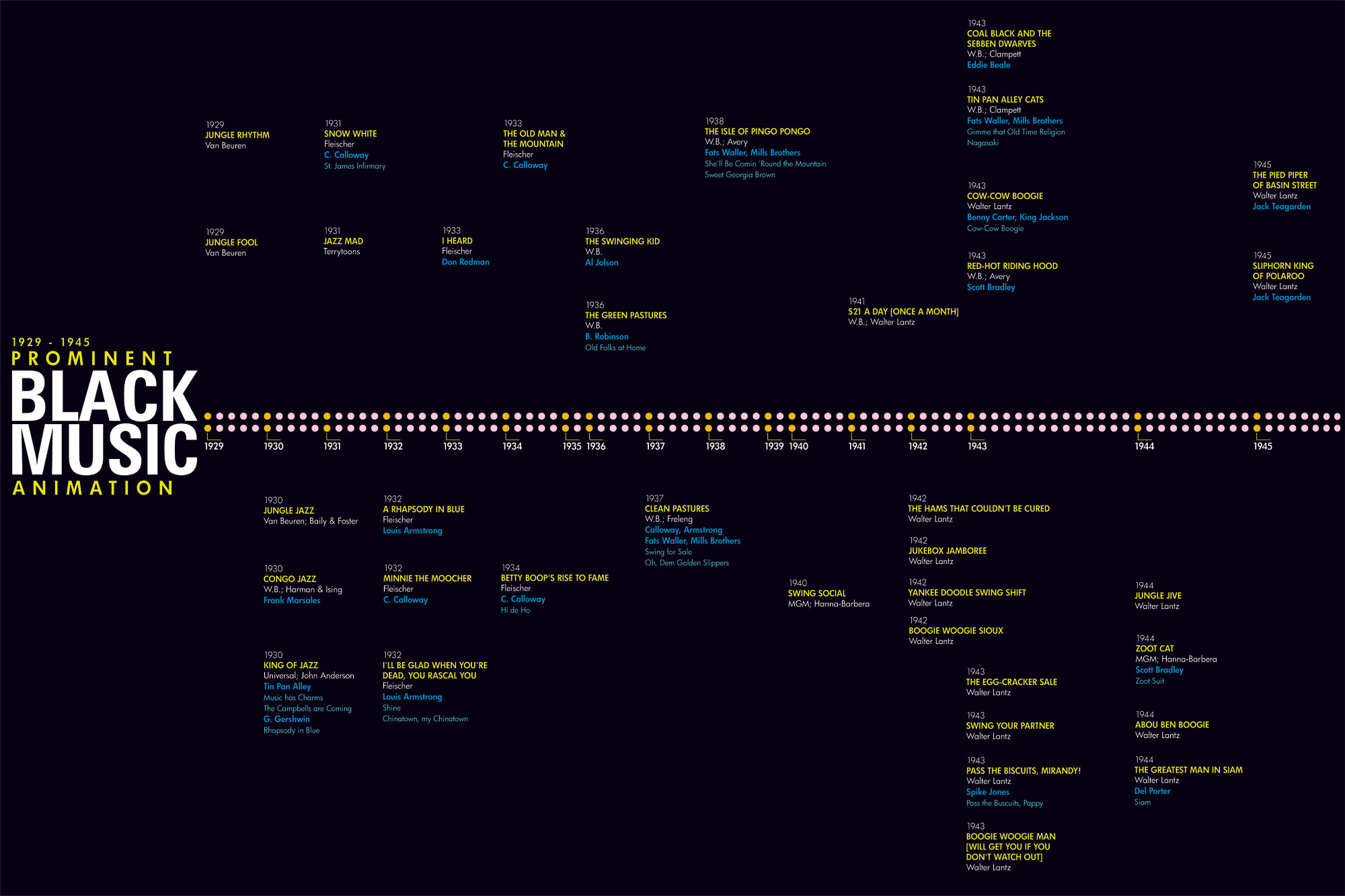
Upon further investigation of the use of sound as a means to further a dialogue with abstraction through animation I was lead to a posting on Cartoon Brew about the utilization of jazz within animation shorts--again not particularly of the non-objective variety, but more as the precursors to the use of jazz and music as an elaboration and companion to abstract forms and content. In explanation of some of the music used as a means of reinforcing the abstracted landscape being created in these animations, a timeline of information was offered to give a sense of how vital jazz and music in general was to the animations during much of the 1930s, 40s, and 50s.

Albert Ammons
 Eldon Rathburn
 Eldon Rathburn
The end of the posting mentions that animators like McLaren carried on this tradition. McLaren is noted for collaborations with jazz artist Albert Ammons, and film composer Eldon Rathburn--both pictured above.
Reference:
Cartoon Brew
|| Post by: Stephanie Clark ||
L'Illusionniste 2010, A Love Letter from Tati

After doing some research and coming up with nothing too remarkably sound-related, I found I couldn't focus on anything after I saw L'Illusioniste last Thursday at Kendall Square Cinema. I first saw advertisements for the film, directed by Triplets-famed Sylvain Chomet, while studying abroad in Paris, and it was unfortunately so close to the end of my stay that I couldn't see it there in a Parisian cinématheque. However, it stayed on my mind since as the one film I was absolutely aching to see-- I had obviously seen and loved The Triplets of Belleville and was super thrilled to see a new film from the creators.
The film is an adaptation of a screenplay written by the late french mime, Jacques Tati, originally written as a letter to his estranged daughter. The story in Chomet's interpretation follows a struggling magician who travels from Paris to Scotland in the 1950's, and along the way meets a young girl who believes his magic to be real. While generally praised for its poetic visuals and fabulous settings and character design, some die-hard fans of Tati's work found Chomet's adaptation ultimately disappointing. There will always be mixed feelings when one filmmaker is charged with the task of adapting the work of another, especially when the latter is deceased-- but I still find this film a piece of its own, and a wonderful and sentimental homage to the legend that was Tati.
-Lily.
Line Dance
Renown Canadian animator Norman McLaren made this short titled "Begone Dull Care" in 1949. Set to Oscar Peterson's jazz ensemble, it does a phenomenal job at visualizing music using simple means. McLaren scratched right onto film to create these great images.
Though the whole piece is totally worth watching, the part I like best begins at 3:32. A number of white lines do a sort of dance against a black background. It is so simple, and yet it fits the animation so well.
Notice all of the nuances he uses to set up a natural visual language to accompany the swells in the music. I especially love the way he uses to lines coming closer together to recreate a tension or build present in the music--fabulous!
-Erik
Mary Ellen bute
 Mary Ellen Bute was one of the first female abstract animators. She first studied painting in Philadelphia but felt this medium did not enable her to use light in the way she desired.She then studied stage lighting at Yale University where she took great interest in the color organ ( a device that demonstrates how sound influences light colors) eventually creating her own. From that point Bute became very interested in electronic art as well as translating sound into a visual animated art form. Bute studied amongst avant-garde musicians Joseph Schillinger and Leon Theremin who collaborated with her on many pieces. Together they used optical color projection synchronized to music. Bute's work is visually poetic focusing on movement form and color exemplified in Spook Sport (1939) and Synchromy No. 4(1938): Escape; Her films also display a great influence of science and mathematics. Although Bute is not very well known today, this was not always the case. Many of her animations appeared in movie theaters as shorts before a feature film. This allowed her work to be seen by a large amount of people a luxury many abstract artists did not get to experience.
In Synchromy No.4 one can definitely see the influence of science and math with the different geometric shapes and grids. These images are combined with a very free flowing background that looks like liquid or clouds.
source
callie
John Whitney

John Whitney is sometimes called the father of computer animation. Although he started by making films on 8mm, and in 1939, he and his brother, James, began to make more abstract films. One of their pieces, Five Film Exercise, was given the first place prize at the International Experimental Film Competition in 1949.
Whitney, having been an inventor and having experience with computers, used these skills to make commercials for television during the 1950's. He, along with Saul Bass, made a sequence for the movie Vertigo, by Alfred Hitchcock. This fulled his interest in using computers to make animations and film. In the 1960's, Whitney opened Motion Graphics Incorporated, where he continued to make motion graphics and sequences for television. IBM saw what Whitney was creating and offered him a job in 1966 as a resident artist. While working, Whitney became interested in the processing language and medium. He used this to create the work Arabesque, a film using lines and color set to music.

I personally found Arabesque to be beautiful and intriguing. I have been taking a course in processing and wanted to see if there was a way I could re-create parts of Arabesque on my own. The code for it took time and involves much more to make the entire sequence that Whitney made, but I found a way to make the linear set that transforms into dots. Here is a link to this piece.
source
|-Kelly-|
Beyond the Caribbean Islands
Out of the many things to love from this wondrous bit of animation I find myself drawn to how the selected muisc really complimented the animation. As opposed to what I felt was the strange proto-darkwave/industrial music of Diagonal Symphony. The pairing of the Afro-Caribbean sounds of Don Baretto with an abstract animation that matches the energy of the music that I associate with my childhood in the Caribbean. At the time this was made the world was turning its ears to music from the Caribbean, Latin and South America from Carmen Miranda to post War I Love Lucy's Rickey Ricardo. There is a primal call to action when most people hear the music to emerge out of the colonization of the new world. Through the color and movement of the work created a sense of a large group of people dancing who are way too drunk off of rum.
Also, it is a prime example of how to get paid doing something you love and are passionate about. Granted, the amount of hustling, who you know, and who is exposed to your work goes a long way. It is still great to see how it can be done and how to able to express one's ideas through a government contract. There is no shame in using your skills and talent to pay the bills any way you can. Len Lye is now my favorite Kiwi surpassing Bret and Jemaine.
-Ben
Why Momotaro?
The story of Momotaro is a beloved bit of folk lore in Japan. It is a story that combines a bit of Moses and a coming of age story. Momotaro is a child of the heavens transported in a peach, which a poor elderly couple were about to eat until the child talked informing them about his origins. When Momotaro turned fifteen he wanted to do something to help his country and set off to Onigashima or Ogre Island to fight the Ogres that have been terrorizing his home. Along the way he befriends a dog, monkey and a pheasant by giving them food. In exchange the trio agrees to help Momotaro. Naturally, the quartet defeated the Ogre menace and returned home with wealth and everyone lived happily ever after.
Knowing this it is easy to see why this story was so popular during World War Two. Brave son on a righteous quest to defeat the enemies of their home country. Then again America at the time wasn't so much different. We did and still do have a paramilitary organization in the Boy Scouts. We saw how american cartoons were made to dehumanize our war time opponents. Plus, after December seventh we had our own campaign to demonize and compartmentalize Japanese-Americans in interment camps. I guess the adage of: "All's fair in love and war" is true.
-Ben
I see Skies of Blue, Clouds of white, Bright blessed day, when I listen to tunes, and I think to myself… “what a colorful view!”
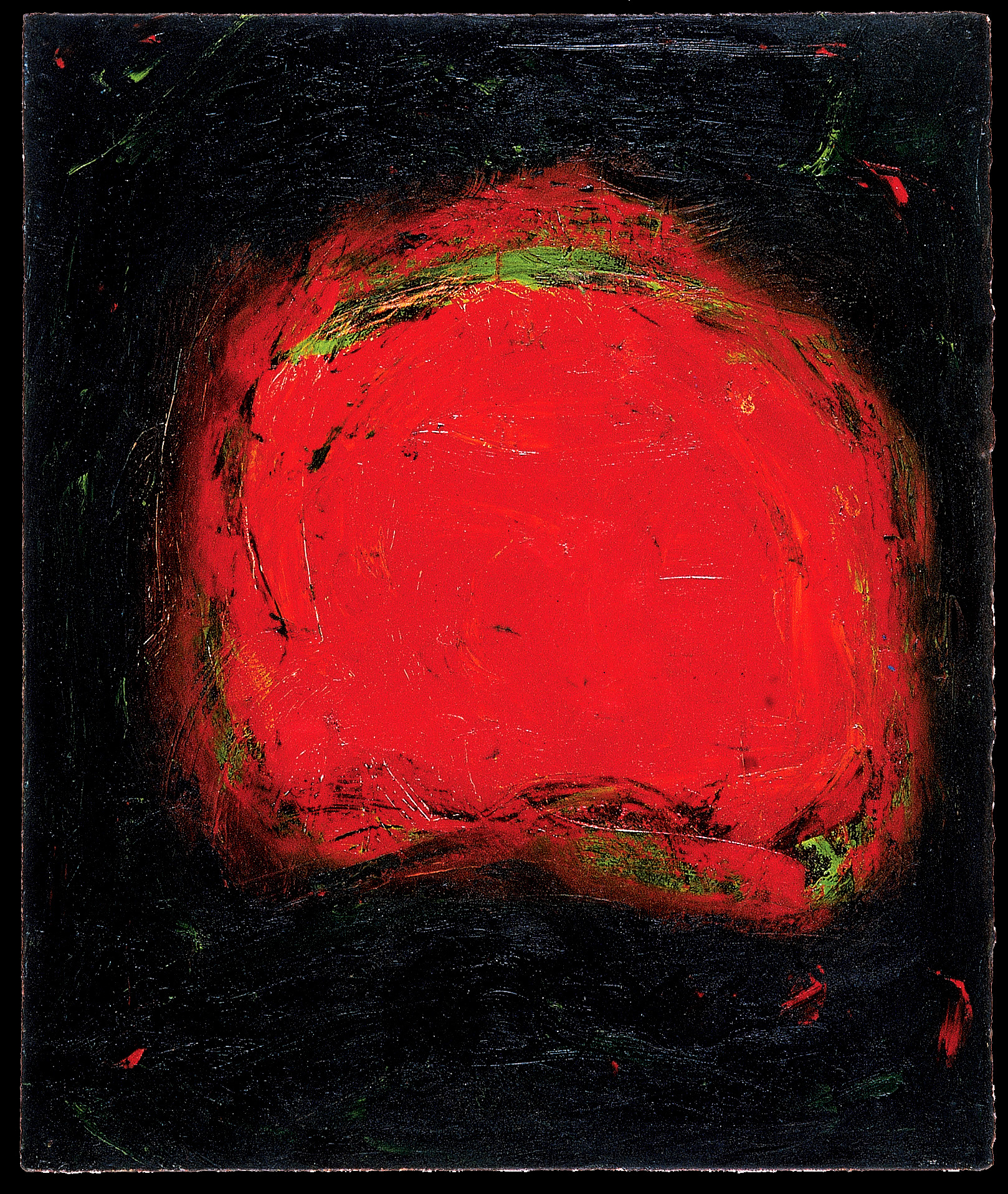
Synesthesia is a rare, yet incredible condition, which allows the individual with said condition to literally see sound! Being somebody with mild Synesthesia, I get a taste of it whenever I listen to music, so I know automatically what to picture when Synesthesia is brought up; but for those of you without the condition, mild, or full blast, what I found to be the most accurate depiction of what synesthetes see or imagine when they listen to music, would be the opening song of Fantasia, when they played Toccata and Fugue in D Minor. It’s actually a very interesting condition, studies show that most synesthetes do not even realize they have the condition until they discover that people around them are not envisioning the shapes, colors, and patterns that they are when they listen to music, or sound. Most cases have shown Synesthesia to be harmless, or non-influential to the subject’s patterns of behavior, however, there are still the occasional few who report experiencing “sensory overloads” when the sensation is triggered. As for what does trigger Synesthesia to synesthetes varies. The most common form of Synesthesia is called “Grapheme” or “color Synesthesia”, which causes letters and numbers to appear to give off colors. For example, S might look like S, or A might look like A. Other forms are Sound Synesthesia, which causes a variety of sounds to look like shapes, lights and colors. It was this form of Synesthesia, which inspired the creation of “Synesthetic Art”, or art that is either created by synesthetes to express what they experience, or artists who are trying to replicate the condition through physical visual means. Such examples would include a variety of inventions, such as the Lumigraph, or “Color Organ” which was developed by an animator named Oskar Fischinger, and would give off colors of light that would accompany the music that the organ would play. Other examples were works of art, such as “Vision” by Carol Steen, which supposedly portrayed what she would picture during acupuncture. For many hundreds of years, Synesthesia was not a widely investigated phenomenon by the scientific community, and it’s only been until recent times when the condition has actually been acknowledged at all. Many famous Synesthetes include ancient Greek Philosophers who described seeing the color timbre when they listened to music. Others include Isaac Newton, who proposed that the frequencies of color and music were interrelated. Even the father of modern electricity, Nikola Tesla was supposedly a synesthete. Overall, Synesthesia is neither a normal sensation, nor a handicap, and throughout history has made significant contributions to both the artistic, and scientific fields, both intellectually, and creatively.
- Jon
(Image is "Vision" by Carol Steen, image was taken from Wikipedia)
Oskar Fischinger's Lumigraph

Being an abstract animator, Oskar Fischinger wanted a machine to help him make spectacular light arrangements to be paired up with music. He invented the Lumigraph, a type of "color organ," a term describing a wide array of electromechanical machines that were capable of producing visuals in accordance with sound. These machines had a variety of ways of doing so. "Color Organ" was a name that arose in the 60s and 70s due to the colorful light shows that these machines produced to go along with music or sound.
Oskar's machine created thin beams of light by exerting pressure on a rubberized screen. The size of the performer dictated how big the screen could be (how high the performer could reach). In order for the device to function properly, operation involved two people. One to maneuver the screen to produce imagery, and another to altar the lights when necessary. Oskar did shows in LA and San Francisco, and the machine was involved in the creation of the movie The Time Travelers in 1964. In this instance, the Lumigraph was referred to as a "Lumichord" according to the producers, not Oskar. Oskar's son constructed two more of the devices varying in size. And the Lumigraph continued to perform at the hands of Oskar's wife after his death. A Lumigraph that she used remains in a museum in Germany, and still performs occasionally.
Info: http://en.wikipedia.org/wiki/Oskar_Fischinger
http://en.wikipedia.org/wiki/Color_organ
Image: http://www.centerforvisualmusic.org/Fischinger/Lumigraph.htm
Post By Luke
Subscribe to:
Posts (Atom)